
Before you hand over your grandmother's gold chain or your old wedding band, there's something critically important you need to understand: how your gold is tested determines how accurately its value is calculated — and that calculation determines your payout.
The One Thing Most Gold Sellers in Tampa Don't Know
Two testing methods dominate the gold buying industry in Tampa Bay. One is a 19th-century technique still used by most pawn shops and casual gold buyers. The other is the same technology used by gold refineries, major banks, and professional dealers worldwide. The difference between them can mean hundreds of dollars in your pocket.
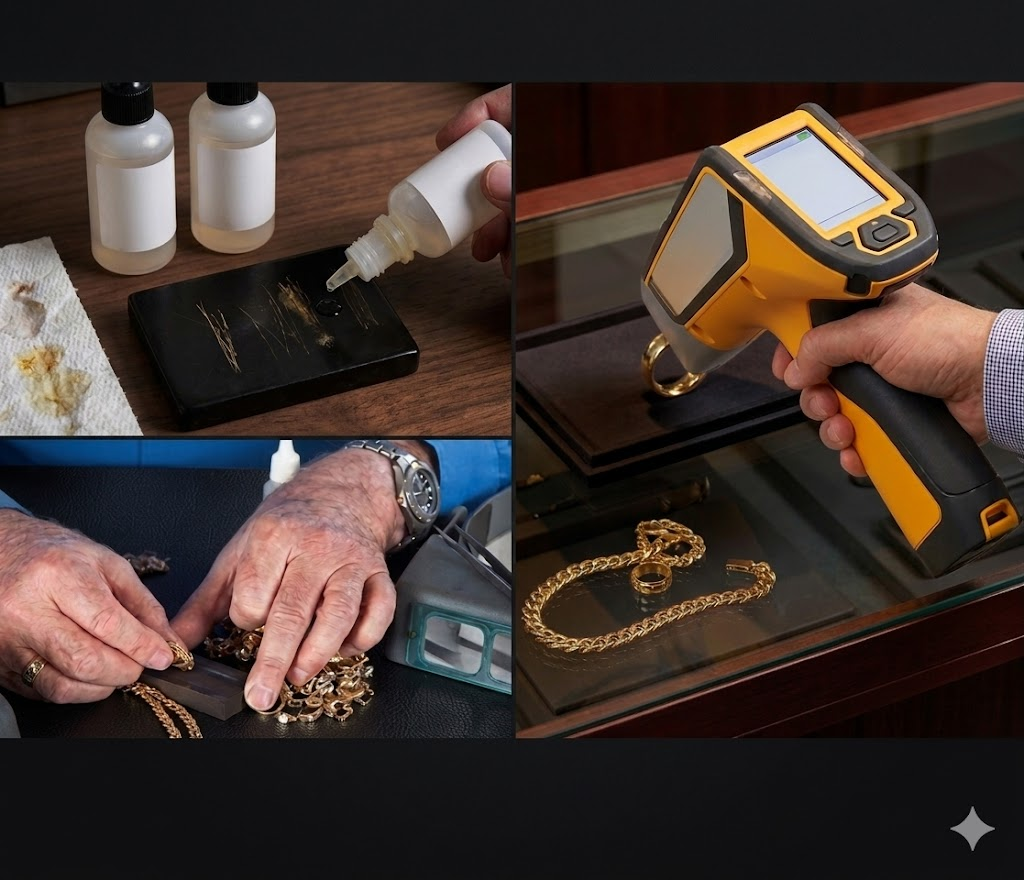
Left: traditional acid testing. Right: professional XRF spectrometer — the Gold Star Jewelry standard.
Method #1: Acid Testing — The Old Way
Acid testing has been used to verify gold purity since ancient times. The process involves scratching your gold against a black testing stone and applying nitric acid (or a mixture of acids) to the resulting mark. The color reaction — or lack thereof — indicates the approximate karat.
How it works:
- The buyer scratches your item against a touchstone
- Acid is applied to the scratch mark
- The reaction color is compared to reference samples
- The buyer estimates the karat based on visual observation
The problems with acid testing:
It's subjective.
The result depends entirely on the buyer's interpretation of the color change. Two buyers can look at the same reaction and reach different conclusions.
It's destructive.
The test physically damages your item by scratching it and exposing it to acid. A piece that enters the process in one condition may exit it in another.
It's hidden from you.
Most acid testing happens behind a counter or in a back room. You see the result — a number — but you don't see the process that produced it.
It's not precise.
Acid testing can distinguish between broad karat ranges (10K, 14K, 18K) but cannot pinpoint exact gold content. A piece that acid-tests as "14K" could be anywhere from 13.5K to 14.5K — a difference that adds up when you're selling multiple pieces or heavy chains.
It's easily manipulated.
Because the process is opaque and subjective, unscrupulous buyers have more room to undervalue your gold. Without precise data, how would you know?
Method #2: XRF Spectrometry — The Modern Standard
XRF stands for X-Ray Fluorescence. An XRF spectrometer works by directing a beam of X-rays at your gold item. The X-rays excite the atoms in the metal, causing them to emit secondary fluorescent X-rays at wavelengths unique to each element. A detector measures these emissions and produces a precise elemental composition analysis in seconds.
In plain English: the machine reads exactly what your gold is made of, down to fractions of a percent, without touching it.
What makes XRF the gold standard:
It's laboratory-accurate.
XRF technology is used by the U.S. Mint, gold refineries, major banks, and professional dealers worldwide. The accuracy is within 0.1% — far more precise than any visual or chemical test.
It's non-destructive.
Your item is placed in the XRF device for a few seconds and removed completely undamaged. No scratches. No acid. No physical contact with testing materials.
It tests the whole piece, not just a scratch.
Acid testing only evaluates the surface where you scratched. XRF reads the entire composition of the metal, accounting for any variation throughout the piece.
It identifies all metals present.
XRF doesn't just tell you the gold content — it shows the complete elemental breakdown: gold, silver, copper, zinc, and everything else. This is critical for accurate valuation.
It produces a printed or digital report.
The result isn't an opinion. It's data. A number on a screen that you can see, question, and verify.
The Tampa Gold Market: What Most Buyers Use
Visit most pawn shops in Tampa Bay and you'll encounter acid testing. It's fast, cheap to perform, and — critically — it keeps the evaluation process opaque. You hand over your jewelry, someone disappears behind a counter, and you're presented with a number you have no way to independently verify.
Some buyers use XRF machines, but still perform the test away from customers. The technology is present, but the transparency isn't.
At Gold Star Jewelry, we do something different: we bring the XRF spectrometer to your home and perform the test in front of you, on your table, with you watching the screen. You see the reading appear in real time. You see the exact gold percentage. You see the calculation that produces your offer.
There is no back room. There is no interpretation. There is no mystery.
Why This Directly Affects Your Payout
Here's a concrete example that illustrates why testing method matters:
You have a 14K gold chain that weighs 25 grams. The true gold content is 58.3% pure gold.
With acid testing:
The buyer eyeballs the acid reaction and calls it "looks like 14K" — but decides to be conservative and prices it as if it were 13.5K (54% purity). On 25 grams, that's 3.25 grams of gold being ignored. At current gold prices near $3,000+ per troy ounce (~$96 per gram), you've just lost $312 on a single item.
With XRF testing:
The machine reads 58.31% gold. The math is precise. 25 grams × 58.31% = 14.58 grams of pure gold. At $96/gram, you're paid on the full 14.58 grams — not a conservative estimate.
Multiply this across a jewelry box of 10-15 pieces, and the difference can be thousands of dollars.
5 Questions to Ask Any Gold Buyer Before You Sell
Before handing over your gold to anyone in Tampa Bay, ask these questions:
1. What testing method do you use?
The answer should be XRF spectrometry. If they say acid testing, that's a significant red flag.
2. Can I watch the testing process?
Any buyer confident in their process will say yes. Hesitation or a "no" means they have something to hide.
3. Will you show me the reading?
The XRF result is a number on a screen. You should be able to see it directly.
4. How do you calculate your offer from the test result?
A transparent buyer will explain: gold weight × purity × current spot price × their payout percentage = your offer. If they can't or won't explain the math, walk away.
5. What percentage of market value do you pay?
Pawn shops typically pay 40-60%. Professional buyers should offer significantly more. At Gold Star Jewelry, we pay up to 90% of live market value.
The Bottom Line for Tampa Gold Sellers
Testing method is not a technical footnote. It's the foundation of every offer you receive. A buyer using acid testing is working with approximations, subjectivity, and a process you can't verify. A buyer using XRF is working with laboratory-grade data — and if they show you that data in real time, you're dealing with someone who has nothing to hide.
When you're ready to sell your gold in Tampa Bay, you deserve to see exactly what your gold is worth — not an estimate, not a conservative guess, but the actual number. Then you can make an informed decision about whether to accept an offer.
That's what transparent gold buying looks like. That's what you should expect.
Ready to experience the difference? Gold Star Jewelry brings professional XRF testing directly to your home, anywhere in Tampa Bay. Free home visit, zero obligation, cash paid on the spot.